Start with the financing job
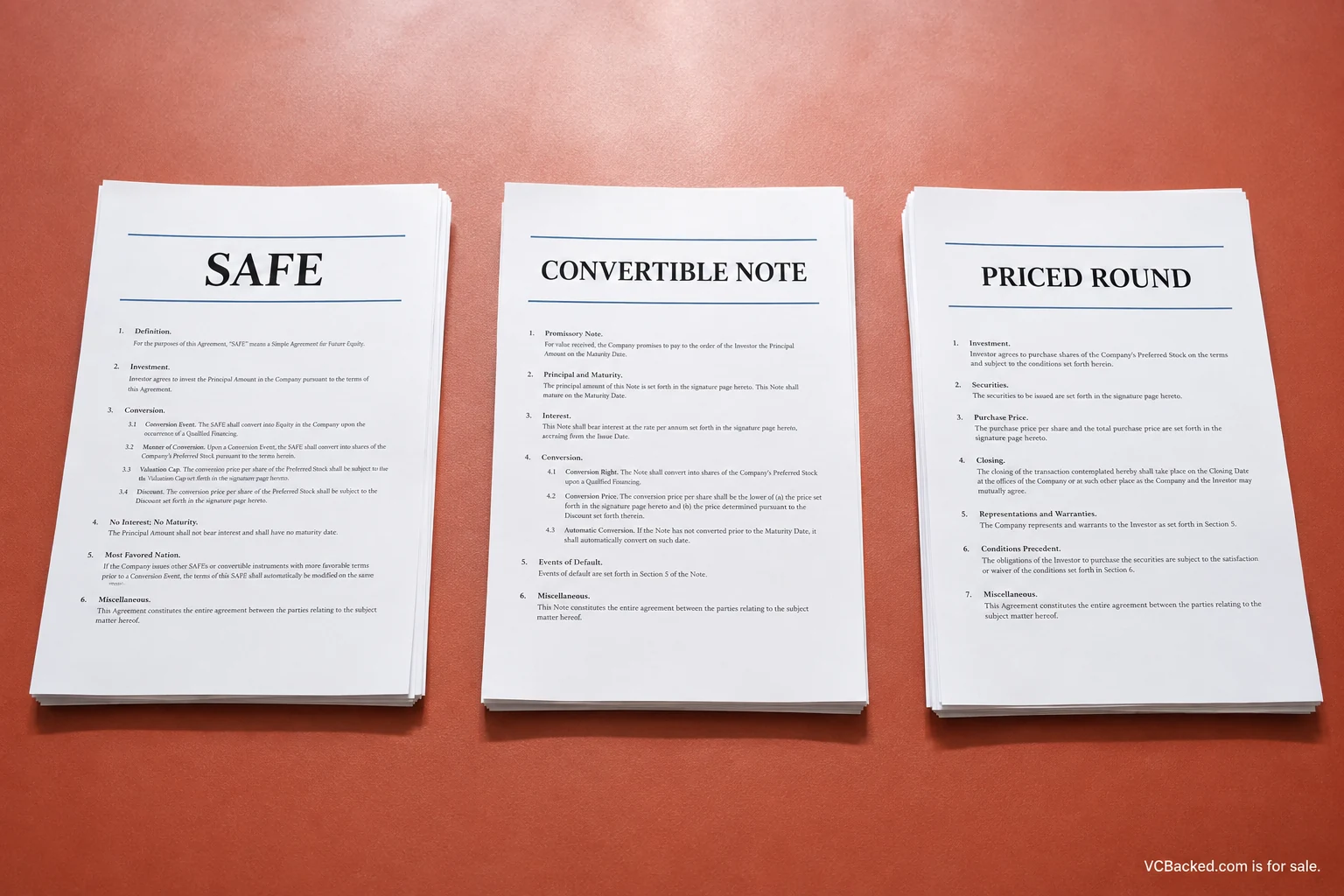
Choosing among a SAFE, convertible note, and priced round begins with the job the capital must do. Consider the amount, investor expectations, company maturity, legal readiness, ownership clarity, and the date by which cash must arrive. A small bridge from existing supporters presents a different problem from a substantial seed round led by an institutional investor. The instrument should fit the transaction rather than serve as a label for company quality. Founders should ask counsel and tax advisers about their specific circumstances, since standard documents still create company-specific effects.
Understand what a SAFE promises
A SAFE is an agreement for future equity. It usually converts when a later equity financing occurs according to terms such as a valuation cap, discount, or most-favored-nation provision. It has no maturity date or interest in the common standard form, which distinguishes it from debt. The Y Combinator comparison explains core differences between a SAFE and a convertible note. A SAFE can reduce early documentation, yet it still allocates future ownership. Founders need a pro forma model showing how each agreement converts under plausible round prices.
Read post-money language carefully
Post-money SAFEs make the ownership sold through the SAFE round easier to estimate relative to company capitalization at that point, but multiple agreements and later option grants still require careful modeling. A founder should record the purchase amount, cap, discount, MFN status, pro rata side letter, and signing date for every SAFE. The Carta SAFE guide provides additional background on SAFE mechanics. Never rely on a folder of PDFs as the capitalization model. Put the instruments into one table, reconcile it to signed documents, and update it immediately after each close.
Know what makes a note debt
A convertible note is a loan intended to convert into equity under defined conditions. It generally includes principal, interest, a maturity date, and conversion terms. Those features can suit investors or circumstances where debt treatment matters, but they also introduce a clock. If the next financing has not happened by maturity, the company and noteholders must address repayment, extension, or another negotiated outcome. Founders should understand default provisions and any security interest, not simply compare the valuation cap with a SAFE. Interest also increases the amount that may convert.
See what a priced round settles
A priced equity round sets a price per share and issues preferred stock at closing. It usually establishes the capitalization, investor rights, governance, and financing documents in greater detail. The process costs more and takes more legal work than issuing a simple convertible instrument, yet it provides a clearer ownership picture after closing. A lead investor may prefer a priced round when the check size, board relationship, or company maturity justifies the structure. The decision should include legal fees, management time, diligence needs, and the value of resolving terms now.

Compare on six practical dimensions
Create a comparison table with speed, legal cost, maturity pressure, ownership visibility, governance change, and investor fit. Then score each dimension against the actual round. Speed can favor a SAFE, debt characteristics define a note, and ownership or governance clarity can favor a priced round. The Startup Fundraising structures describes the three financing structures in a broader fundraising context. A founder should also test whether the expected investor set will accept the chosen instrument. A theoretically efficient structure does little good when it prevents the right participants from reaching agreement.
Model several conversion cases
For SAFEs and notes, calculate conversion under a low, expected, and high priced-round valuation. Include caps, discounts, interest, option pool changes, and any pro rata participation. Show founder, employee, and investor ownership on a fully diluted basis after each case. The exercise reveals when instruments that looked small in isolation create a large combined position. It also helps founders explain the future table to the board. Keep assumptions in separate cells, document the formulas, and have counsel or a qualified capitalization adviser review the model before relying on it.
Watch the cost of stacking
Convertible instruments are often closed one at a time, which can obscure their cumulative effect. Different caps, discounts, and side letters make the conversion order harder to follow. Set a maximum amount for the round, update the pro forma after every signature, and review the total with the board. If fundraising continues beyond the original plan, reconsider whether a priced round now provides a cleaner answer. The instrument that was suitable for the first check may become awkward after the tenth. Operational convenience today should be measured against capitalization clarity tomorrow.
Match documentation to the decision
Use current, jurisdiction-appropriate documents and record every approval. Store signed agreements, board consents, investor details, payment evidence, and the current cap table together. Confirm that the names and amounts match across all records. A side letter is part of the deal even when it sits outside the main agreement. The Datapile instrument comparison offers another current comparison of the instrument choices. Legal counsel should explain clauses in plain language and flag where a document differs from the expected standard. Founders remain responsible for understanding the business consequence.
Make a reasoned choice
A SAFE can fit a fast early financing when the parties accept deferred pricing and the company models dilution. A note can fit a bridge where debt terms and a conversion trigger serve the parties. A priced round can fit a larger, led financing where ownership and governance should be settled. None is universally superior. Write a one-page decision memo with the financing job, alternatives, model results, investor feedback, legal advice, and board decision. That record gives the company a clear explanation later, when the documents convert or a new investor studies the history.
Review after the financing
After funds arrive, compare the final documents and capitalization table with the decision memo. Record every continuing obligation, including information rights, pro rata rights, maturity dates, board changes, and future approval requirements. Set calendar reminders for items that can expire or become urgent. Share a plain ownership summary with the board and keep the detailed model controlled. A clean review catches closing discrepancies while counsel and investors still have the transaction in mind. It also gives the next financing team a coherent history instead of a collection of disconnected agreements.